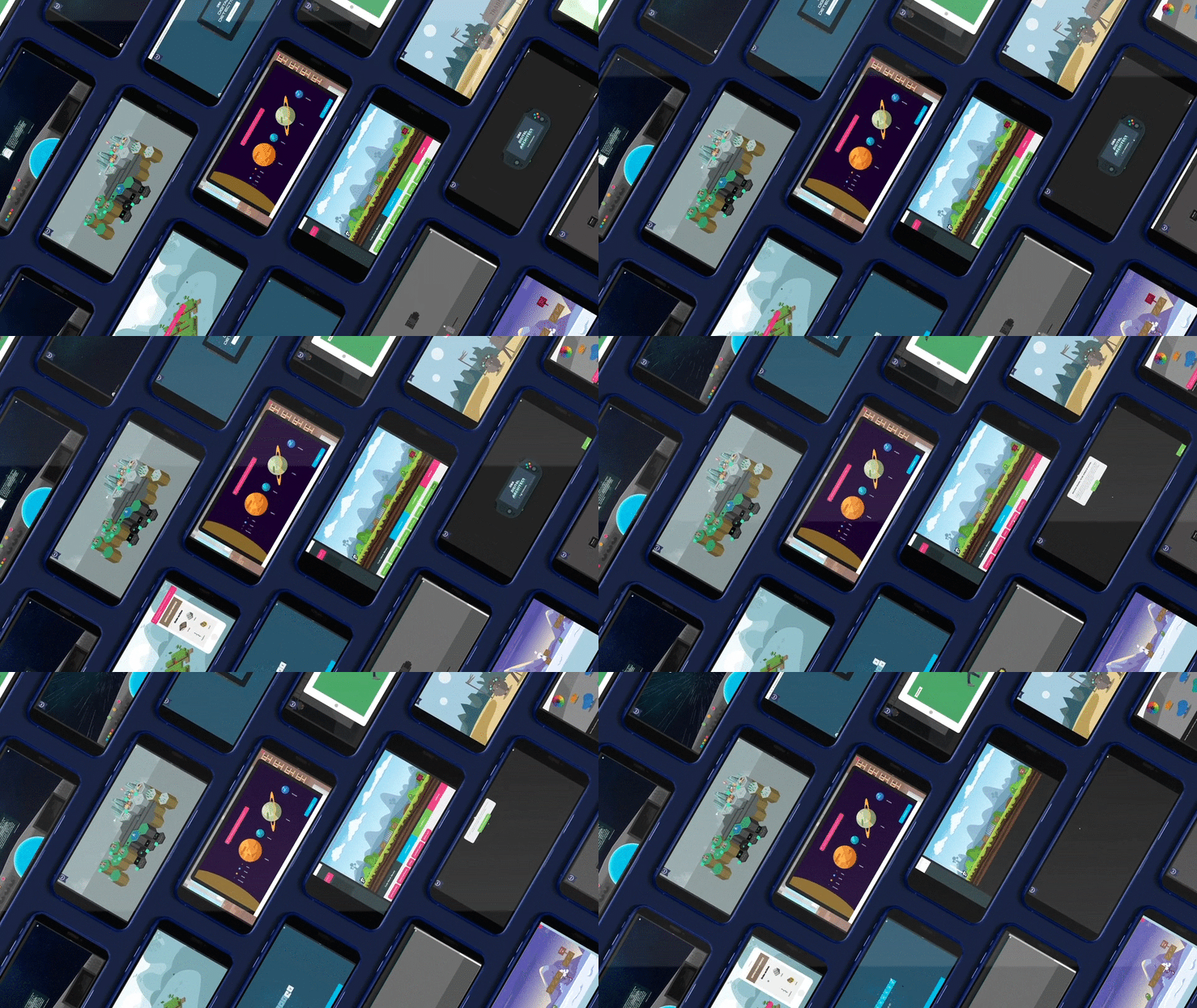
Week 11 was all about this university's employability service, Real WORKS. After working through parts of week 11's challenge activity, the Art of the Approach course (THE ART OF THE APPROACH, n.d.), I felt putting this and week 12's content about considering the next module together was a great opportunity to step back as we near the end of the first module and reflect on what I want my MA to do for my career and beyond.
A reminder of where I started before the course
When I started this course, I was at a pivotal point in my life and career. As a family, we had decided to move from the UK to Norway, and I had sold my business of ten years as part of that. It was a hard decision, but one made for the benefit of my whole family.
At that point, I had 13 years of experience in the digital industry designing, developing and directing games and digital content, having built up an agency in London (Toasted Digital, n.d.) specialising in education and not-for-profit. I've had the privilege of working with some incredible people and organisations during that time and have worked on projects reaching millions that have helped educate through interactivity and play. Most of my experience over the last five years is rooted in learning and gamification.
Although I'm really proud of the work I've done so far, after running the agency for ten (often very stressful, highly pressured) years, it felt like the timing was right to try something new. Or rather, I wanted to take the experience and develop it in a focused, new direction.
This is where my MA and a new job came into play.
So what do I want to develop in my MA to take into my professional work?
When I look back over the last ten weeks, a few themes keep emerging as areas that I want to explore further in my studies.
Playtesting for serious games
The first is playtesting. As I've discussed in previous blogs, I've had lots of experience in user experience testing (Week 8: Research & Ethics | Sam Vestby-Clarke, 2021), so what do I want to improve on and develop? All of my work is now focused on game design and development, and professionally I am working in serious game development.
So improving the design of learning-based games through playtesting is an area I am super keen to explore. My hope is that it'll help improve my professional work and potentially further this area of research. Studies have shown (Strzalkowski and Symborski, 2016) the value of playtesting at an early stage to validate the pedagogical impact of the learning, and I plan to implement this in my next learning-based project.
The effect that game feel has on players of serious games
As I have a gamification background, learning in games is an important focus for me. But in wanting to develop this further, I've become more and more interested in how different elements of games affect players' ability to learn.
I've drawn on the (Swink, 2009) definition of Game Feel since the start of the course, and it has repeatedly come up as an area of study for me. My research so far has shown limited and sometimes conflicting conclusions about what contributes most to a player's learning journey when playing a serious game.
For example, while it's been concluded in one study that elements like look and fun don't necessarily improve learning outcomes (Strzalkowski and Symborski, 2016), and that aesthetic visual appeal makes children like educational games better, but not actually learn better (Javora et al., 2018) - others have shown that fun is a factor in motivation to continue engaging with a game (Iten and Petko, 2014).
But what is less studied (if at all) is the effect that Game Feel can have on learning motivation and outcome. Does the tactile sensation of being connected to the virtual world itself impact a learner's journey? I'd like to research this further in my studies and hopefully implement it professionally.
Collaboration
Collaboration keeps returning as a theme and, in particular, the topic of communities in practice. I still maintain the goal of participating in a Game Jam this year, and I think this could positively impact my professional work. Having just started a new lead game developer role, it's a great opportunity to flex my ability and learn from others in a fun space.
Unity upskill
This was one of the goals I had coming into the course, and my positive ongoing experience with it has further concreted that I want to keep developing Unity as my core engine for game development for the foreseeable future. I'm using Unity in a professional capacity as well.
Next Module - Indie Game Start-Up
So my next module is Indie Game Start-up. I'm really looking forward to a more directed focus on gaming, and it'll be interesting to be able to study and reflect on the start-up element in a very different environment to the way I have worked with start-ups before.
I've run and sold a start-up before, and currently work for one, so I'm familiar with lots of the concepts that we'll be exploring. That said, what this current module has taught me is that space for time and reflection gives the opportunity to find new ideas and develop skills in a deeper way, even (and perhaps especially so) on things I already have experience with.
From what I understand, we'll have the opportunity to create an indie game, although I am unsure if that is just a game design document or a playable prototype. In either case this is a good chance to look at and begin to structure some of the wider questions on playtesting and learning I have listed above, and to start linking them to potential business objectives.
In particular, one area that seems very relevant is the gaming community and its importance on the commercial success of a game. After reviewing the module content, if there is one area I hope to bolster during this module, it's my understanding of this and how to navigate it and use it to make better games with a better chance of success.
The final project
It's a big question to ask at this stage - the final project. But I do feel based on the above that a clearer idea of what I want to produce is emerging.
So as a preliminary idea for a final project - I want to produce a serious game in which I can test the impact of game feel on how players learn.
It's a challenging brief because game feel itself is incredibly difficult to get right, and it may well turn out to be beyond the scope of what I can produce during this course, but given we're not tied to it, it's a goal I'm happy to end the module on.
List of Figures
Figure 1. Vestby-Clarke, S., 2021. A selection of Gamified Learning modules I designed and developed for iDEA Foundation - But where next?. [image] Available at: <https://indie.samvestbyclarke.com/bl-content/uploads/pages/1532d2ea58642af430736d685d0b3edb/idea-high.gif> [Accessed 10 August2021].
References
Iten, N. and Petko, D., 2014. Learning with serious games: Is fun playing the game a predictor of learning success?. British Journal of Educational Technology, 47(1), pp.151-163.
Javora, O., Hannemann, T., Stárková, T., Volná, K. and Brom, C., 2018. Children like it more but don’t learn more: Effects of esthetic visual design in educational games. British Journal of Educational Technology, 50(4), pp.1942-1960.
Realworks.careercentre.me. n.d. THE ART OF THE APPROACH. [online] Available at: <https://realworks.careercentre.me/resources/taskmanager/default.aspx?ProgrammeID=0CEjEGg1TYV2%20GCek1zfiQ==> [Accessed 10 August 2021].
Strzalkowski, T. and Symborski, C., 2016. Lessons Learned About Serious Game Design and Development. Games and Culture, 12(3), pp.292-298.
Strzalkowski, T. and Symborski, C., 2016. Lessons Learned About Serious Game Design and Development. Games and Culture, 12(3), pp.292-298.
Swink, S., 2009. Game Feel: A Game Designer's Guide to Virtual Sensation. 1st ed. Elsevier.
Toasted Digital. n.d. Toasted Digital® - Digital Agency for Charity, Culture & Education - London. [online] Available at: <https://www.toasteddigital.com/> [Accessed 10 August 2021].