This week's challenge brief
Now we have explored a variety of techniques for helping to foster creativity and generate new ideas, let’s experiment with some of these ideation techniques.
Begin this activity by selecting one or more of the ideation techniques discussed this week, then apply them to the following challenge:
- Choose an existing artefact that is the output of someone’s creativity. This could be a poem, short story, illustration, song or anything else you think is interesting.
- Modify the artefact in some way using the techniques you selected. The aim is to remediate it into another form of artefact.
The term ‘remediation’ is used here in the same way that Grusin and Bolter intended in their book, Remediation: Understanding New Media. The term denotes a framework for “considering how all media constantly borrow from and refashion other media”(Bolter et al, 2003), and this is exactly what we want you to do in this task.
As with all attempts to channel inner creativity, there are no rules for this exercise. Instead, you are encouraged to dive straight in and not think too hard about it. Select your initial artefact, blast through the ideation techniques to find ways to modify it and let the output happen organically. You might devise something that could be deemed a ‘success’ or it might be nonsensical and random (in our eyes this is equally a success). The point is not to aim for perfection and instead generate many ideas that could be improved upon if they show potential.
The artefact I chose
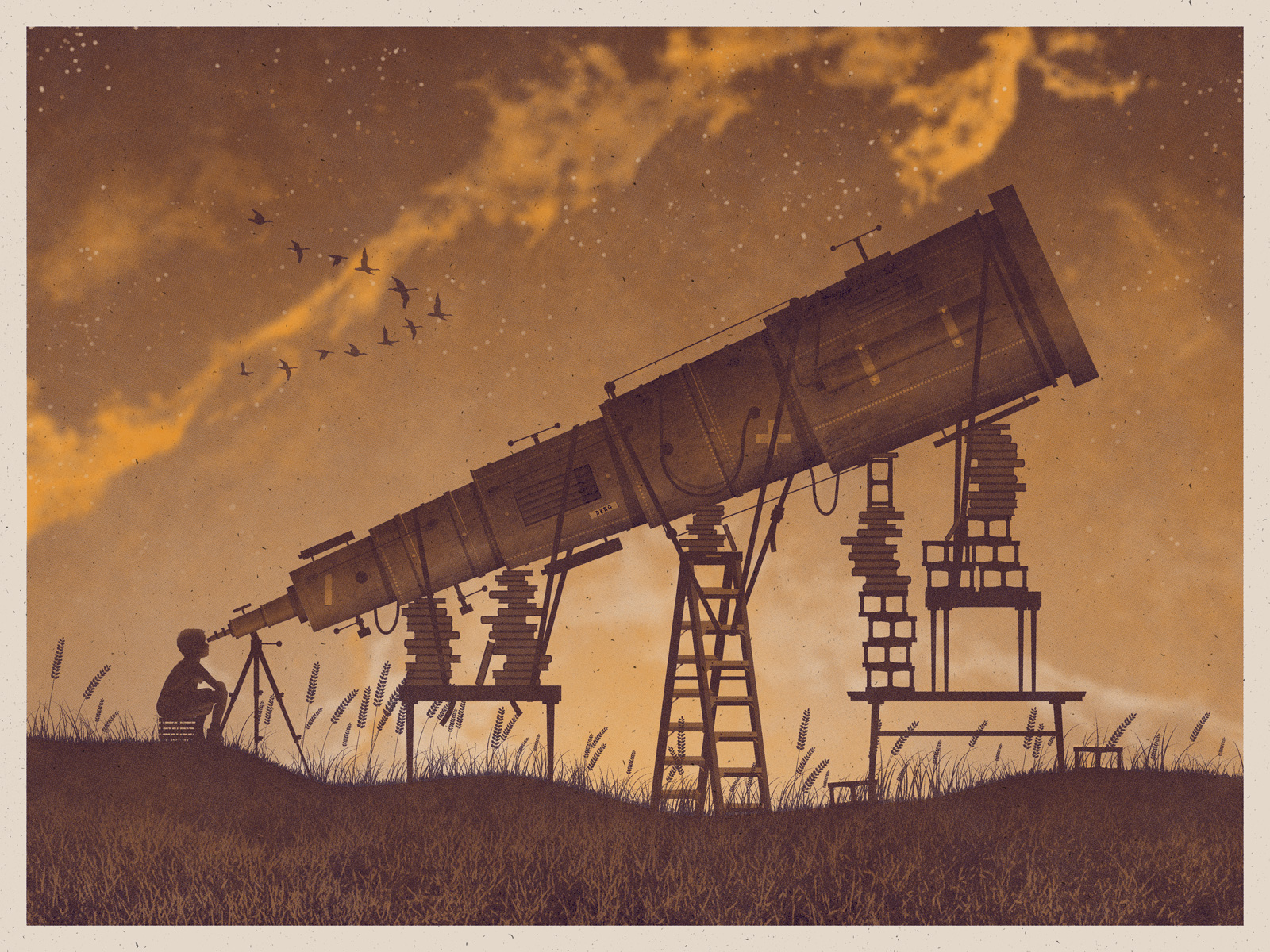
I decided to remediate a piece of artwork I have up in my living room. It's a two-colour screenprint by a studio called DKNG. They produce illustrations largely in the music and entertainment industries, which is very often based on existing media. Whenever I look at it, it gets my thoughts going, so I decided it'd be an interesting piece to work with.
My approach
In the spark forum this week we were asked to think about times where we had to channel our own creativity.
For this Spark forum, think about times when you have needed to channel your own creativity. What did you do to foster this and did it change the way you see things? (Falmouth University - Week 2 Spark forum)
I talked about some of my professional creative techniques and in particular the need for space within high pressured commercial environments. The method I spoke about was the idea bank. This is where each week some time would be set aside for free thought and creativity. It could be an aimless walk or any activity that lets your mind wander. The only condition is that you write down an idea at the end, whatever it may be. This enables the build-up of a bank of ideas that can later be developed when time is not on your side.
So when it came to choosing an ideation technique to remediate the creative artefact I chose, I wanted to challenge this way of doing things with a method that is a little more confined.
Crazy Eights
"Crazy 8’s is a core Design Sprint method. It is a fast sketching exercise that challenges people to sketch eight distinct ideas in eight minutes. The goal is to push beyond your first idea, frequently the least innovative, and to generate a wide variety of solutions to your challenge." (Google, n.d.)
Crazy Eight's is the technique I chose due to its time-constrained nature. This was a great way to challenge my preferred way of generating ideas and seeing what I could come up with.
I approached it without any constraints in terms of the type of creative artefact I'd produce, and finished on these eight ideas:
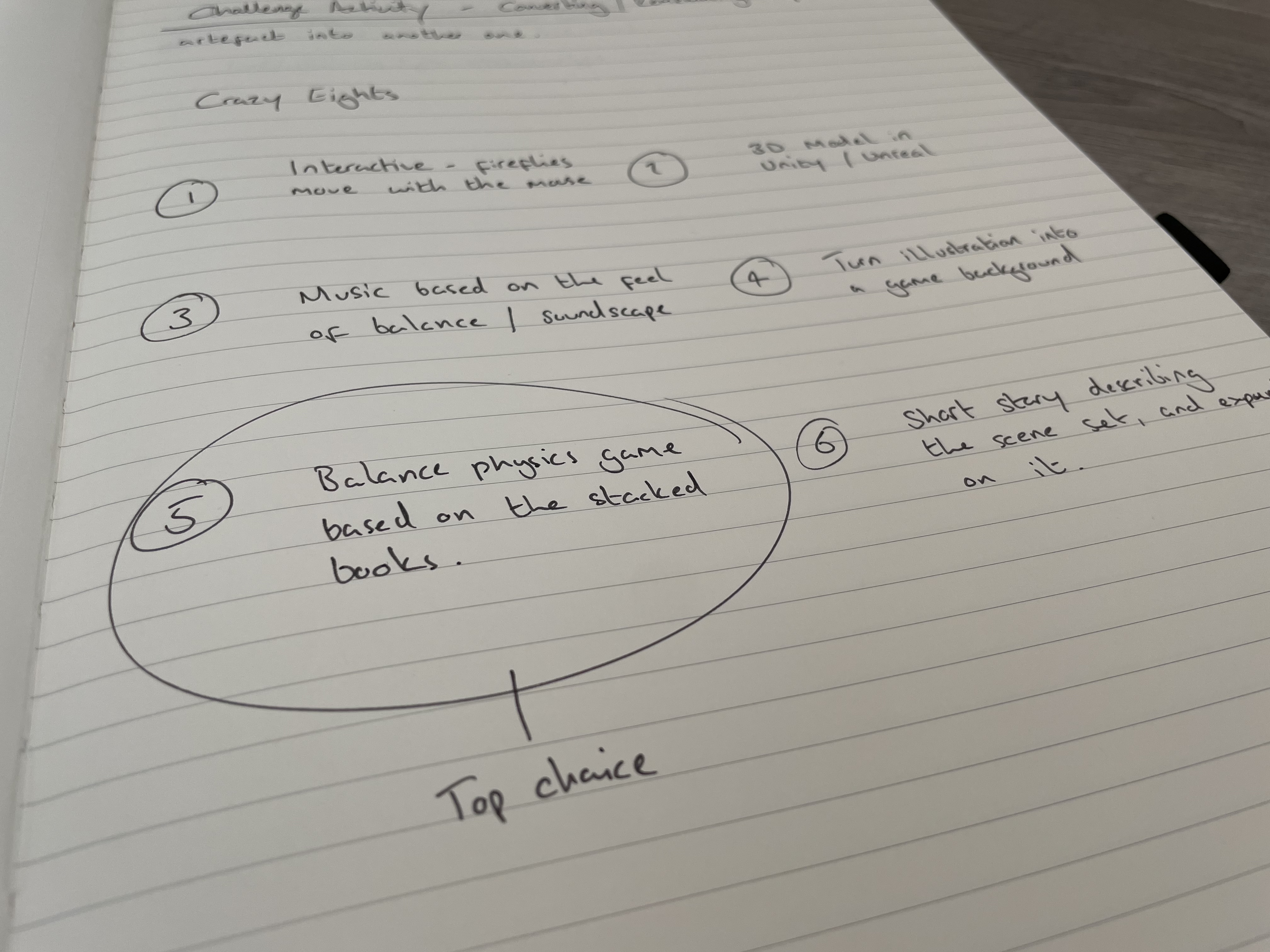
- Interactive - Fireflies move with the mouse
- 3D Model in Unity / Unreal
- Music based on the feel of balance/soundscape
- Turn an illustration into a game background
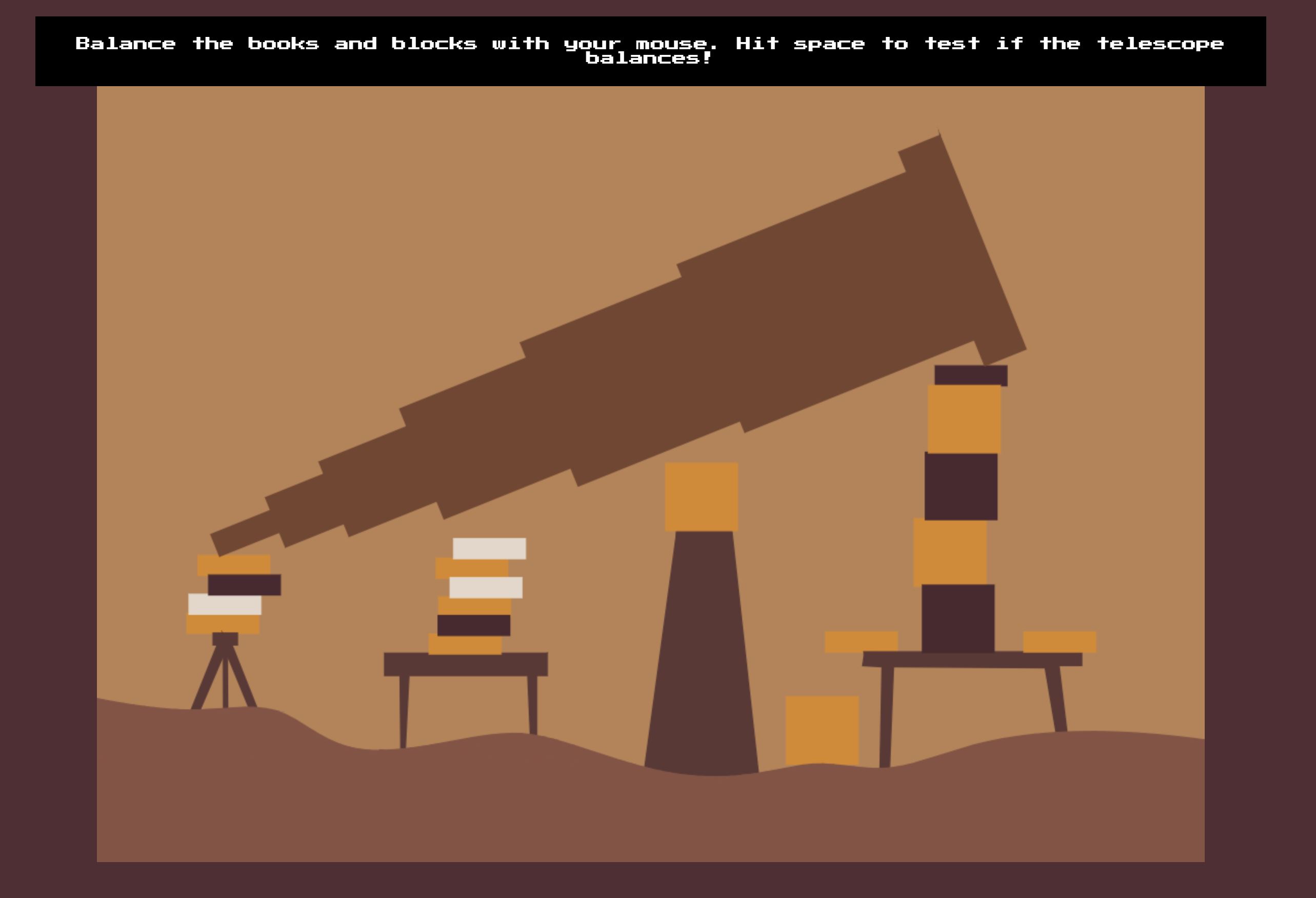
- Balance physics game on the stacked books
- A short story describing the scene set, and expanding on it
Time / MVP
Next up I broke down how long each would take, to eliminate anything that would be out of the question. I considered the tools and libraries I had available and my general ability in that area. This left me with four ideas that I thought I could make a minimal viable product out of.
Finally, I chose the idea that I thought would connect best with the original artefacts creative tone and message. I chose to make a balance physics game.
The Game
To make the game, I used a few libraries that I knew I could mock up a quick playable prototype that looked true enough to the original in.
I knew that matter.js was a good place to start as it gives some great out-of-the-box functionality to quickly introduce the stacking mechanism into the game.
The biggest challenge was producing the shapes in the time I had available. The solution I landed on was using SVGs. With SVGs I could quickly mock up the shapes in Illustrator, then create the bodies from the vertices, generated from SVG paths.
var vertexSets = select(root, 'path')
.map(function(path) { return Vertices.scale(Svg.pathToVertices(path, 10), 0.75, 0.75); });
Finally, to make sure we had some gameplay, I used jQuery to create a very simple UI input that lets the player control when the telescope appears.
The game is playable here.
Summary
It was a fun experience trying to remediate something in such a small amount of time. Although I am familiar with Crazy Eight's it's never been my preferred technique, so seeing that I was able to generate ideas that translated into a mini-game within hours was a real eye-opener.
I'd like to develop using ideation techniques on a more granular level within a project. For example, once I'd decided on the game, I no longer drew on the techniques at all, and instead just produced it pretty organically.
It'd be interesting to try techniques like cut-ups and in particular SCAMPER to think up gameplay ideas in additional sprints and I'll be integrating that moreso into my workflow going forward.
List of Figures
Figure 1. Vestby-Clarke, S., 2021. Week 2 Challenge Activity Game. [image] Available at: <http://indie.samvestbyclarke.com/bl-content/uploads/pages/5394d89194da9eb6dc827819c63e1cee/prototype.jpg> [Accessed 8th June 2021].
Figure 2: DKNG, 2012. Telescope Art Print. [image] Available at: https://www.dkngstudios.com/blog/2012/09/12/telescope-art-print [Accessed 8th June 2021].
Figure 3. Vestby-Clarke, S., 2021. Crazy Eight's Result. [image] Available at: <http://indie.samvestbyclarke.com/bl-content/uploads/pages/5394d89194da9eb6dc827819c63e1cee/Photo11-06-2021,114509.jpg> [Accessed 8th June 2021].
Figure 4. Vestby-Clarke, S., 2021. Week 2 Challenge Activity Game. [image] Available at: <http://indie.samvestbyclarke.com/bl-content/uploads/pages/5394d89194da9eb6dc827819c63e1cee/prototype.jpg> [Accessed 8th June 2021].
References
Bolter, J. and Grusin, R., 2003. Remediation. Cambridge, Mass: MIT Press.
Falmouth University. n.d. Falmouth University - Week 2: Challenge Activity. [online] https://flex.falmouth.ac.uk/courses/912/discussion_topics/22194?module_item_id=54082 [Accessed 8th June 2021].
Falmouth University. n.d. Falmouth University - Week 2: Spark Forum. [online] https://flex.falmouth.ac.uk/courses/912/discussion_topics/22193?module_item_id=54078 [Accessed 8th June 2021].
Google, n.d. Crazy 8's. [online] Design Sprints. Available at: https://designsprintkit.withgoogle.com/methodology/phase3-sketch/crazy-8s [Accessed 11 June 2021].