
Challenge activity
One of the best ways to hone your prototyping skills is to reverse engineer the finished work of other practitioners you admire. This allows you to practise with the various tools and unpack the design theory behind the work in question.
To complete this activity, identify an artefact you feel is particularly interesting. This could be anything from an inventory system UI for a game to a museum website that utilises AR or VR. The more experimental and interactive the artefact you choose, the more challenging this prototyping activity will be.
Select one or two of the prototyping methods outlined this week and build quick prototypal representations of your chosen artefact. Note down any interesting characteristics of the artefact. Perhaps, you notice the colour palette is used in a certain way, or the layout follows a standard grid system. Depending on your chosen artefact, you might want to annotate the dimensions and analyse the padding and spacing used. If you are creating a storyboard for a cutscene in a game, you could identify key components of the narrative arc or highlight various camera shots and how they are used to create drama.
This is an extremely open brief designed to allow you the freedom to choose an artefact you will find enjoyable to reverse engineer. We want you to dive in and have some fun. Don’t take the task too seriously – instead, enjoy trying to get inside the minds of other creative practitioners.
The artefact - Detective Grimoire
(SFB Games 2014)
I love point-and-click adventure games.
Part of these games usually involves a puzzle-solving mechanism driven by collecting information and items, using them correctly in conversations or with other items, and progressing.
While I love the storytelling element of these games, one stand-out game that has designed the deduction element of this really well is Detective Grimoire (SFB Games, 2014). It's a really satisfying experience, which does a fantastic job of making you feel you have owned the solving of the puzzles yourself.
Game Maker's Toolkit has a well thought out video analysis of what makes a great detective game (Game Maker's Toolkit, 2017). It suggests a key element of making a player feel they are owning the process of deduction, is to make sure hand-holding, and prompting is kept to an absolute minimum. The less there is, the more the player feels a satisfying process to the deduction.
So how does the Detective Grimoire deduction mechanic fit this analysis, and how?
Reverse engineering - The Deduction Screen

First off, slow down and break it down.
I had to think about the exact element of the game I would reverse engineer. Detective Grimoire has lots of interesting mechanics - way too many to reverse engineer in a week - so I am focusing solely on the deduction screen and the mechanics behind it (figure 2).
This is where the player pieces together evidence gathered to solve a puzzle to progress the story.
Solving a problem
Point and click adventures or story-led games often come up against the same issue. While their storytelling can be fantastic, the gameplay is a little lacking as multiple-choice mechanics mean you can quite easily guess your way through the game.
Got it wrong once? No problem, just click one of the other three options. Repeat until correct. Yawn.
So how does this gameplay mechanic solve that and achieve the goal of a satisfying deduction mechanic?
Enter The Wireframe
I decided to reverse engineer the screen using a wireframe (figure 3). I chose this method because it helps design the underlying conceptual structure of the mechanic, which would help me answer the following questions:
- What elements are required to make it function?
- Why is the Detective Grimoire mechanic successful?
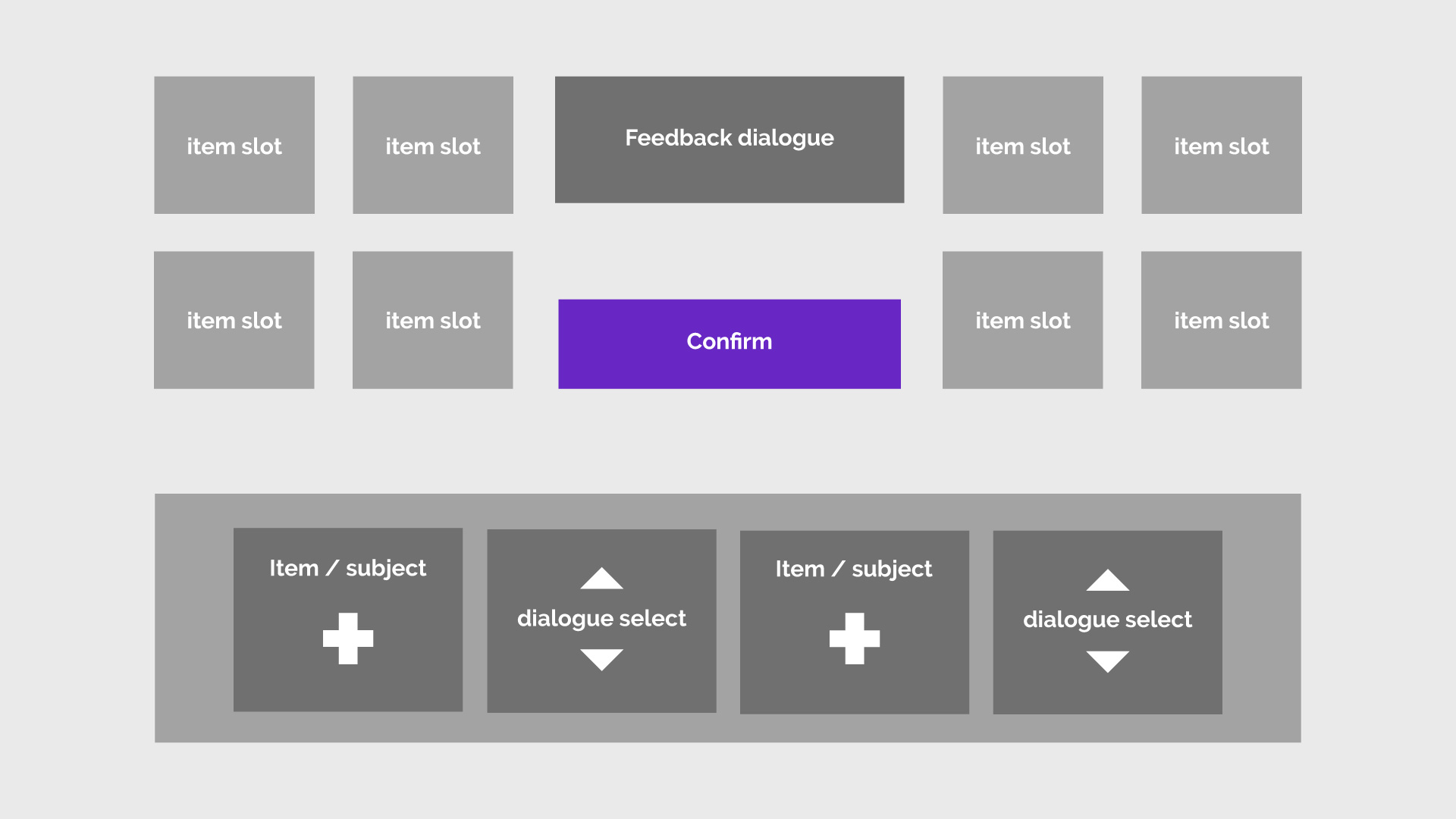
From this wireframe, I have been able to break down the elements required to make the gameplay mechanic function:
- Eight item-slots, which can consist of people, locations and items.
- Two text pickers where you can select connecting text
- A "thought builder" where you construct it all
- A confirm button, and a feedback box
This gave me the information necessary to understand why the deduction system works to prevent users from simply guessing.
By design, this generates way too many possibilities to guess! Unless you have a lot of time on your hands.
In fact, with eight potential items to drag into two slots and two pickers, each with four options, that's 8 x 4 x 7 x 4.
That is 894 possible combinations!
So that solves that. But it doesn't solve everything. Simply having lots of options isn't a successful gameplay mechanic in itself. I don't fancy scrolling through a list of 894 options, for example. So let's break it down further (figure 4). Here is what each element of the thought builder consists of:

Item / Subject
These can be a person, an item or a location. You only get these as options from interacting with the world around you. You need to solve other clues, find items and visit locations.
In other words, these items are a collection of things that you have personally experienced in the game. You have collected them, so have ownership over them. It isn't a seemingly random list of possibilities.
Dialogue Select
As I understand it, these are built from your experiences and, in particular, from talking to people, mixed in with some (constructive) signposting from the game itself.
The thought builder
The thought builder itself is the final piece of the mechanic that elevates it to a usable piece of gameplay. Using four slots - two which allow drag-drop of visual objects and two which allow selection of connecting text - is a manageable and digestible way to work your way through those 894 possible ways to put thoughts together.
Bringing it all together
The Detective Grimoire deduction screen works so well because it brings all these elements together.
- It has too many options to guess
- It has a cleverly designed user interface to allow you to navigate such a large number of options.
- The player is invested in the options available through wider gameplay experiences in the game.
This all results, in my opinion, is a really satisfying and suitably challenging gameplay mechanic when a thought comes together. It's all about designing a mechanism that makes a player feel they have contributed to that "Eureka" moment, as summarised in Game Maker's Toolkit's video What Makes a Good Detective Game (Game Maker's Toolkit, 2017).
The red herring!
One additional mention found in the game is the red herring, which injects a little more challenge into the mix of options.
This is an item/option that has absolutely no use. Great.
Disclaimer!
One notable exception to this that I can think of is in The Secret of Monkey Island (LucasArts, 1990), where it's used as a joke reference - A literal red herring, which later turns out to have an actual use in solving a puzzle.
That aside - Red herrings in the deduction system are a great way to inject some more challenge. From a player perspective, they force you to think about another possibility. From a mechanic perspective, they increase the options available, making the probability of the player simply guessing the answer lower.
Summing up
Using a prototype to reverse engineer a gameplay mechanic taught me a few valuable things. When I started this task, I tried to think about something I liked, but I didn't ask why.
Even thinking about wireframing threw up questions before I started, such as "What actually makes a good deduction puzzle?". Through researching the topic, and the eventual wireframe, it was surprisingly simple to answer my questions. Better still, it got me asking others. For example, why am I invested in the items available on the screen?
Next steps
My original plan was to do a playable game prototype, but I did not have the time due to work and moving commitments.
However, I don't necessarily think I would have learned more in this exercise from doing that.
The biggest takeaway from this week is that when it comes to my next full game build, I'll definitely be researching and reverse engineering smaller aspects of other games to spark wider thought and ideation. It is a great way to start building questions that need answering and designing solutions that make better gameplay experiences.
List of Figures
Figure 1: Maraga, 2021. Red Herring concept in communication. Flat vector illustration. [image] Available at: <https://www.shutterstock.com/image-vector/red-herring-concept-communication-flat-vector-215668735> [Accessed 19 June 2021]. Licence Obtained.
Figure 2: SFB Games, 2014. Grim Screen 07. [image] Available at: https://sfbgames.com/press/detective_grimoire/images/grimscreen07.png [Accessed 19 June 2021].

Figure 3. Vestby-Clarke, S., 2021. Detective Grimoire Reverse Engineer Prototype 01. [image] Available at: <http://indie.samvestbyclarke.com/bl-content/uploads/pages/c694a15df18da88b34089a8080d83e82/-dg-wireframe.jpg> [Accessed 19th June 2021].
Figure 4. Vestby-Clarke, S., 2021. Detective Grimoire Thought Builder Break Down. [image] Available at: <http://indie.samvestbyclarke.com/bl-content/uploads/pages/c694a15df18da88b34089a8080d83e82/break-it-down-week-3.jpg> [Accessed 19th June 2021].
References
Game Maker's Toolkit, 2017. What Makes a Good Detective Game?. [video] Available at: https://www.youtube.com/watch?v=gwV_mA2cv_0 [Accessed 19 June 2021].
LucasArts, 1990, The Secret of Monkey Island. [Floppy Disk] Amiga. San Francisco LucasArts
SFB Games, 2014, Detective Grimoire. [Digital] iOS, PlayStore, Steam. London SFB Games
SFB Games, 2014. Detective Grimoire - out NOW on STEAM!. [image] Available at: <https://www.youtube.com/watch?v=dpECiUisgGs> [Accessed 19 June 2021].