
This week is all about reflection.
I found a really useful place to start was a deep dive into what reflection is. Is it evaluation, a review of practice? Or is it something deeper?
reflection, in the conventional sense that I have sought to reclaim, is a form of deep thought, emerging in conditions of solitude and slowness, in which the mind engages in a synthesizing process that tends to produce original ideas, insights, and perspectives. (Rose, 2013)
This to me really sums up well what we're doing on the course so far - what else is it all for, if not to seek a deeper understanding that could lead to original thought?
In the lecture content, we were encouraged to go over our previous blog entries and tag which entires match the five reflective domains discussed in this week's course material (Parker, n.d.). These are:
The Five Reflective Domains
Dispositional domain
Time management, motivation, general behaviour and discipline.
Affective domain
How you deal with feelings, experiences and emotions. It relies on emotional intelligence, awareness and self-assessment.
Interpersonal domain
The skills required to interact with others. They include communication (verbal and non-verbal), listening, negotiation, problem-solving, decision-making, and assertiveness.
Cognitive domain
The assessment of your strengths and weaknesses in your approach to learning and finding pathways to learning that will help you achieve your goals.
Procedural domain
Assessing the skills you already have and identifying where you must make improvements.
Results
Reflecting on reflecting feels strange to do, but my results surprised me, so consider me converted.
I tagged my posts as honestly as possible, and even if an entry touched on a domain unless it was clear cut I did not include it.
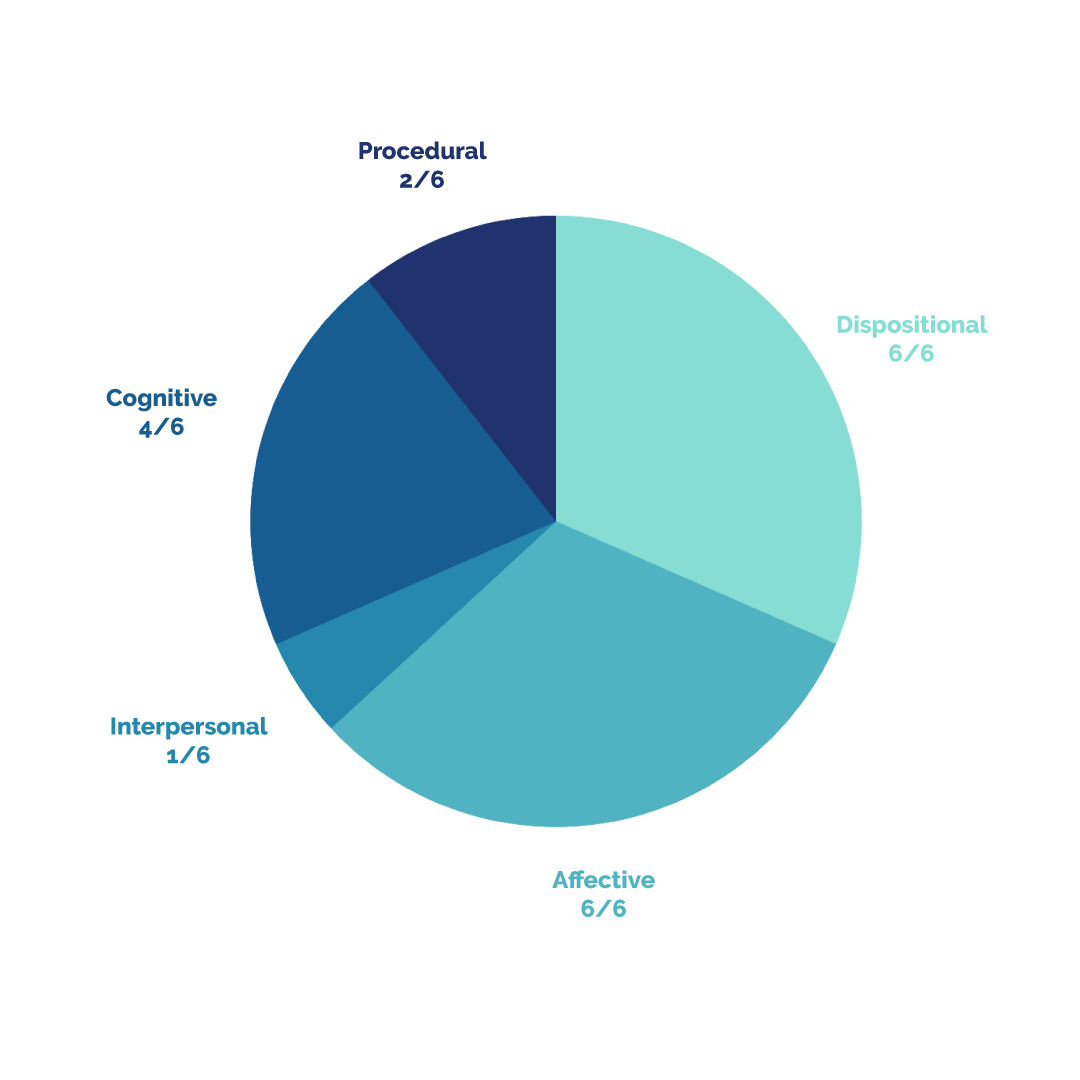
First things first, it's quite an unbalanced state. I'm happy to see that dispositional and affective always feature, and I think this is down to my professional career equipping me with those skills.
Cognitive and procedural both need a bit of work - I need to put a little more emphasis on challenges I faced, and how I got through them, or what I plan to do about it. Having worked commercially for so long, I'm far more used to sharing polished work, and although I'm very comfortable with feedback and analysis, I need to include a little more of it in my reflective writing by identifying weaknesses or improvements needed and setting actionable goals.
The biggest surprise was the lack of interpersonal reflection in my writing so far, as this has been a fundamental part of my career so far. I feel I've interacted a lot with my peers on the course, but that hasn't come through in my reflective writing yet so I will definitely be looking to improve in that area. I should be better at keeping notes from webinars and referencing spark forum discussions and discord.
SMART Goals
Using the above results, we were asked to create smart goals that build on the reflection in the highest priority entries.
SMART goals (Doran, 1981) are a way of helping form plans of action - in this case, based on critical reflection - that are relevant to the growth of your subject, whether your own ability or even business. SMART stands for:
| S | Specific |
| M | Measurable |
| A | Attainable |
| R | Relevant |
| T | Timebound |
Reflection and next steps
Before I set my SMART goals, reflection on this reflection is needed!
This week has been an eye-opener for me. As I've found my feet on the course (which I'm very much enjoying) it's time to start refining my academic practice further. With work and an international move on the go, I've been stretched for time at some stages but should have more time in a few weeks once we get settled in our new home.
So - Using reflective time, and the feedback from the peer review assignment, I've identified a few weaknesses in my practice that need bolstering, and from that, I've got some key areas to work on.
- More reflective focus in my blog posts on areas I need to improve on and learning pathways I want to take (Cognitive and Procedural domains).
- More inclusion of interpersonal reflection in my CRJ.
- Work peer-reviewed sources into my research (Google Scholar is a good starting point here).
So from these areas, I have some SMART goals to work with:
My SMART goals
- To identify 1-2 areas of improvement needed in my existing skillset in each weekly CRJ.
- To identify 1-2 areas of weakness and challenge in my learning, and include a goal to overcome (or a description of how I did) in each weekly CRJ.
- To include interpersonal domain reflection in at least 75% of my weekly CRJs.
- To include research from three peer-reviewed sources before the end of the module.
And one aspirational goal:
- To produce an MVP full game in Unity and C# by the time I graduate from Falmouth University.
List of Figures
Figure 1. Giphy, n.d. Jurassic Park Mind Blown GIF by Spotify. [image] Available at: <https://giphy.com/gifs/spotify-play-streaming-SbtWGvMSmJIaV8faS8> [Accessed 8 July 2021].
Figure 2. Vestby-Clarke, S., 2021. Results of my review of previous posts. [image] Available at: <http://indie.samvestbyclarke.com/bl-content/uploads/pages/cad5ea6c94f6c778a6458013dd3bfb74/reflection.jpg> [Accessed 8 July 2021].
References
Doran, G.T., 1981. There’s a SMART way to write management’s goals and objectives. Management review, 70(11), pp.35-36.
Parker, A., n.d. The Five Reflective Domains. [video] Available at: <https://flex.falmouth.ac.uk/courses/912/pages/week-5-the-five-reflective-domains?module_item_id=54107> [Accessed 8 July 2021].
Rose, E., 2013. On reflection. Toronto: Canadian Scholar's Press, p.107.